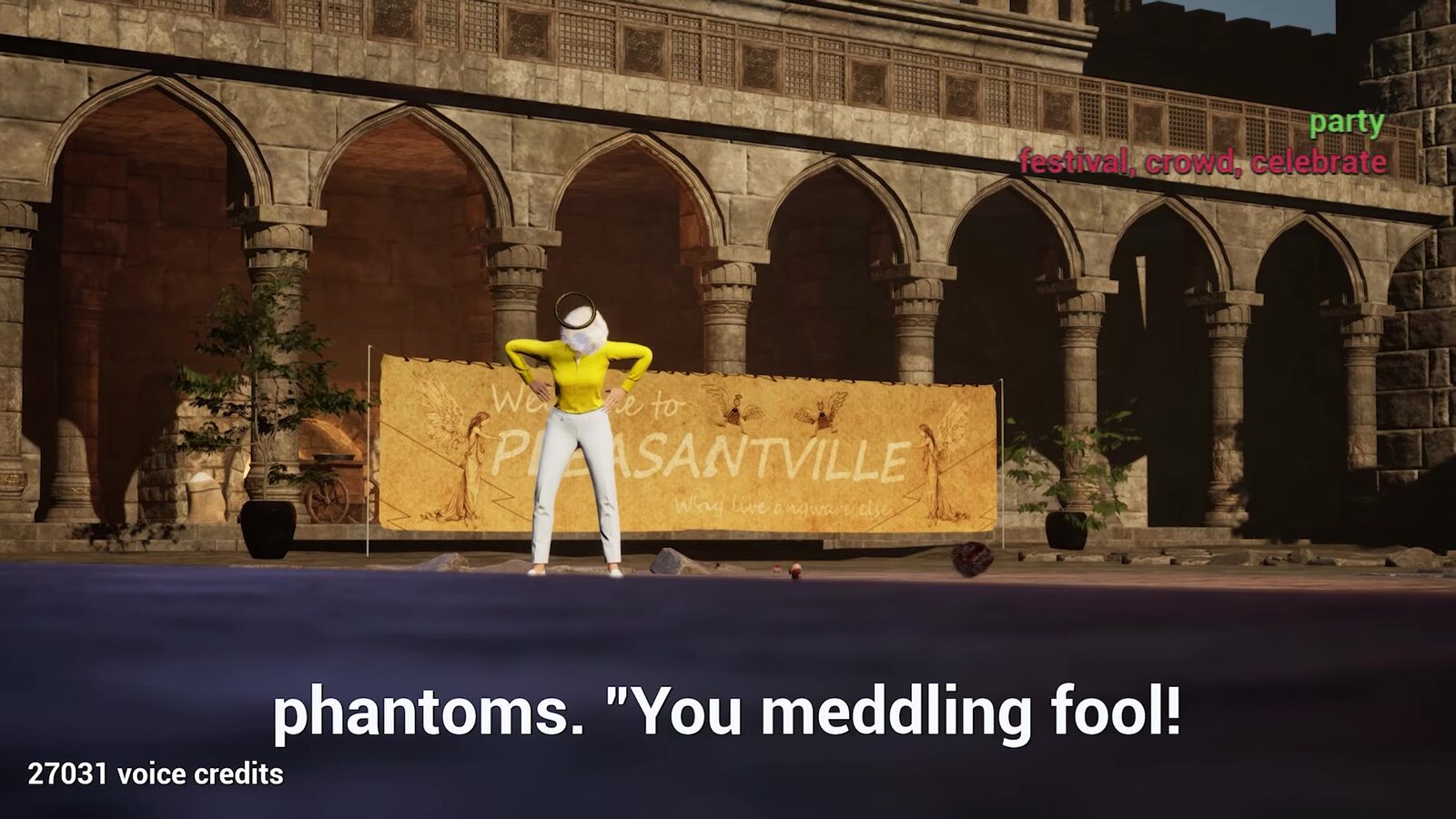
At its core, the Shouldermen angel and devil game asks players to do something deceptively simple: get an AI character to say a specific word. No combat, no platforming, no inventory management. Just conversation. That simplicity is what makes it one of the most challenging design problems we have tackled, and one of the most rewarding to watch players solve.
The Anatomy of a Conversation Puzzle
Every puzzle in Shouldermen follows the same basic structure. A target word is hidden behind the personality of an AI character, and the player must steer dialog toward that word using nothing but their voice. Think of it as a conversation puzzle game where the solution is not a code or a key but a carefully guided exchange of ideas. The player speaks, the character responds, and somewhere in that back-and-forth the password must emerge naturally.
The word itself might be concrete, like "lighthouse," or abstract, like "forgiveness." Early on, we discovered that the most satisfying puzzles use words that feel organic to the character speaking them. If the angel is discussing redemption and the target word is "mercy," the player feels like they genuinely persuaded someone rather than tricked a machine. That distinction matters more than almost anything else in the Shouldermen gameplay experience.
Why Two Characters Change Everything
The angel and devil shoulder game format gives us two fundamentally different conversation partners, and that duality is the engine of our puzzle design. The angel tends toward sincerity, empathy, and moral reflection. The devil leans into pride, temptation, and sharp wit. When a player approaches the angel looking for the word "sacrifice," they might appeal to compassion and tell a story about selflessness. The same player hunting that word from the devil might frame sacrifice as a strategic move, something done for personal gain disguised as nobility.
These contrasting personalities mean that even identical target words create entirely different puzzles depending on which character holds them. Players must read the room, adjust their tone, and think about what motivates each character. It is persuasion in its purest form, and it turns every level into a miniature study of how language shapes relationships.
Balancing Difficulty Without Breaking Immersion
Difficulty tuning in a dialog driven game on Steam is nothing like adjusting enemy health or jump distances. We cannot simply make the AI "harder" without risking conversations that feel stilted or adversarial in an unnatural way. Instead, we control difficulty through several levers. The obscurity of the target word is the most obvious. Getting a character to say "rain" is far easier than coaxing out "kaleidoscope." But word rarity alone is a blunt instrument.
The more nuanced approach involves character resistance. Each character has topics they gravitate toward and topics they avoid. The devil does not like admitting weakness. The angel resists cynicism. Designing puzzles around these conversational blind spots forces players to find creative detours rather than asking directly. We also vary how literally the word must appear. Some puzzles require the exact word; others accept close synonyms. This lets us create a difficulty curve that feels natural rather than arbitrary.
As we explored in our post on why voice-controlled games are the future of interactive fiction, the voice interface adds another layer entirely. Players are not typing carefully constructed sentences. They are speaking in real time, improvising, stumbling, and sometimes discovering approaches they never planned. That spontaneity is a feature, not a bug.
Player Psychology and the Art of Persuasion
What surprised us most during playtesting was how quickly players developed genuine persuasion strategies. Some approach the Shouldermen voice controlled game like a negotiation, building rapport before steering toward the target. Others treat it like a word association game, rapidly shifting topics to surround the target word until the character stumbles into it. A few players discovered that provoking an emotional reaction, making the devil angry or the angel sorrowful, could shake loose words the character would otherwise guard carefully.
One memorable interaction involved a player trying to get the devil to say "kindness." Direct approaches failed immediately. The devil mocked every attempt. So the player started arguing that kindness was actually selfish, a tool people use to manipulate others. The devil, delighted by this cynical reframing, launched into an enthusiastic rant about how "kindness is the greatest con ever invented." The word appeared not because the player forced it, but because they understood what the character wanted to believe.
Another player needed the angel to say "darkness." Rather than bringing up anything negative, they asked the angel to describe the moment just before dawn. The angel spoke about how darkness is not the absence of hope but the space where hope gathers strength. The puzzle solved itself through poetry.
Designing for Surprise
These moments are why we build conversation puzzles instead of traditional ones. Every player finds a different path. Every session produces dialog that has never existed before and never will again. The Shouldermen gameplay loop is not about memorizing solutions. It is about understanding two characters well enough to guide them somewhere new.
If you want to learn more about the world these characters inhabit and the ideas behind the game, visit our about page. And if you are ready to test your own persuasion skills against an angel and a devil who have no intention of making it easy, Shouldermen is available now on Steam. The password is waiting. The only question is whether you can talk your way to it.